
The rapid expansion of the variety of stone today does not allow builders to accumulate experience in its use under various climatic and operational conditions. In such conditions, assessing the quality of the stone and its suitability for stone cladding can be determined by an external inspection by an independent qualified specialist using non-destructive testing equipment.
The suitability of the stone for use in stone cladding under various conditions can only be established more accurately and reliably based on laboratory studies of its physical and mechanical properties. It is also important to consider the integrity of the supplier as a whole. It is no secret that laboratory tests characterize, for example, Jura Limestone as a finishing material that withstands up to 250 frost resistance cycles when directly tested in fresh water. However, it should always be remembered that the selection of material for a specific project is entirely the responsibility of the supplier.
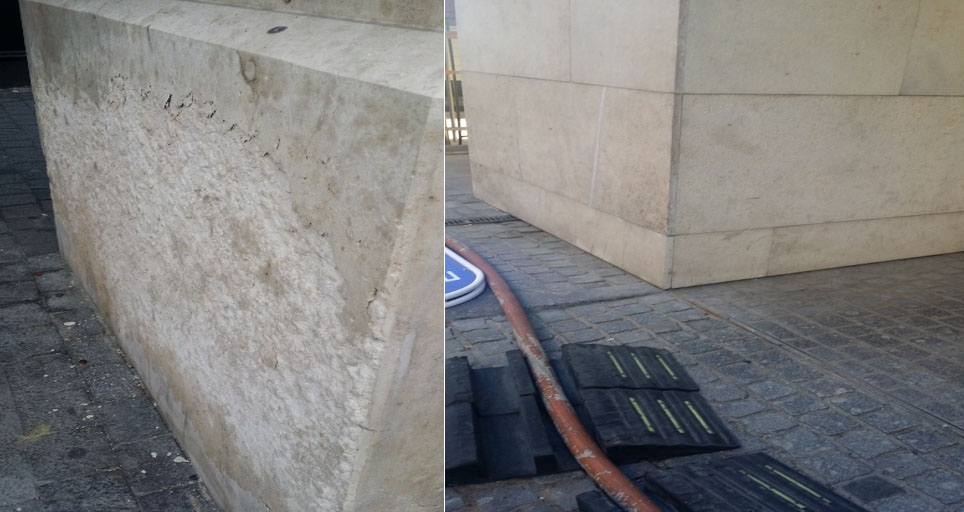 🔍
🔍Here is an example of the plinth of two public buildings. On the left, it is deteriorating, while on the right, it remains in operational condition and will serve for many more decades.
GOST 9479-2011 "Blocks of rocks for the production of facing, architectural-construction, memorial and other products" provides for the definition of 10 mandatory parameters, which include: average density, water absorption, compressive strength in dry condition, reduction of compressive strength after water saturation, abrasiveness, resistance to impact, atmospheric resistance (acid resistance, salt resistance), specific effective activity of natural radionuclides, decorativeness, presence of harmful impurities.
At the same time, for different groups of rocks, Table 3 of this GOST establishes different tolerances. Marble and marbled limestone are included here in one group of medium-strength rocks, for which the average density is set at no less than 2600 t/m³, water absorption is no more than 0.75%, and the compressive strength in dry condition is at least 50 MPa, with a reduction in strength upon water saturation of no more than 30%.
However, it should be noted that marble in its primary state was limestone. The layers of accumulated limestone, when the blocks of the Earth's crust moved, either rose upwards, in which case they were destroyed in the process of geological weathering, or sank deeper. The immersion could reach several kilometers or more. As is known, with depth, the temperature increases, on average by 10°C for every 100 meters.
Under the influence of high temperatures, immense pressure, and hydrothermal solutions, structural changes occur in limestone. Calcite [CaCO3], which is in a cryptocrystalline state (grain size less than 0.001 mm), recrystallizes, its grain size increases, and the grains fill the gaps between organic fragments, filling large organic debris. The nature of the stone's porosity has a huge impact on its physical and mechanical properties.
The smallest pores, abundant in limestone, can have different properties regarding moisture and air depending on their origin and formation conditions. Some pores can be completely filled with water, while others are isolated and do not fill with water. There are pores that are partially filled with moisture during water saturation, while part of the chamber continues to contain air. Some pores appear as narrow channels where water does not freeze even at significant negative temperatures.
The quantitative ratio of different types of pores ensures the limestone's resistance to frost, its frost resistance. As is known, water expands when it freezes, destroying the stone. The more pores with non-freezing water and air pockets there are in the stone, the more frost-resistant the stone is, since the voids that are not filled with water act as a damper, softening the destructive effect of freezing water.
For limestone, GOST 9479 provides a group of low-strength rocks, where these rocks are divided into dense limestones and porous limestones. For limestones in this group, the average density and water absorption are not standardized. Not because low density and high water absorption are good, but because for this group of rocks, such parameters are individual and have a wide range of values. The relationship between the quality of limestone and its density and water absorption does not adhere to general rules; such a relationship for this type of stone is strictly individual. The compressive strength limit for porous limestones is set at 10 MPa, while for dense limestones, it is 25 MPa, respectively. The requirements for reduced strength under water saturation for porous and dense limestones are the same and set at 35%.
Jura Limestone is classified as limestone with low to medium marbleization. Depending on the layer, it provides different average values for the characteristics specified in GOST standards. It is very important to know that only the 10-11; 14-17, and 21-25 layers of Jura stone are used for exterior finishing. With professional selection and grading of the stone, taking into account the achieved frost resistance of 250 cycles, the stone will not deteriorate throughout the entire projected service life of the building.
 🔍
🔍The wall of the British Embassy in Moscow on Smolenskaya Embankment is made of Jura Limestone from JuraLimestone GmbH. The stone has a service life of over 20 years.
During the process of recrystallization, the primary porosity characteristic of limestone decreases, and with complete recrystallization (marbleization) of the rock, it is completely eliminated. In marble, a different type of pores appears - these are the pores of the intergranular space. The relationship of such porosity with the quality of the stone has a different dependence; this dependence is of a general nature, therefore, requirements for density and water absorption have been introduced for marble.
The recrystallization of limestone alters other parameters of the physical and mechanical properties of such rocks. The faces of the growing carbonate grains meet each other, begin to grow into one another, and bend. In the absence of pores, this leads to a significant increase in the strength properties of the stone, primarily to an increase in the values of the compressive strength in a dry state and flexural strength.
We have considered the two extreme members of the limestone-marble series. The intermediate link of this series is called marbleized limestone. In this case, GOST 9479 does not take into account the degree of recrystallization (marbleization). In nature, there is a wide variety of rocks in natural deposits that occupy the intermediate link between limestone and marble with varying degrees of recrystallization, from the first percentages to 80-90. As our studies have shown, depending on the degree of recrystallization (marbleization), the physical and mechanical properties of such rocks can differ dramatically from primary limestones and marbles.
Thus, with an average density below the standard requirements, the compressive strength of some varieties of Jura Limestone (Jura Gold) can reach 181.7 MPa, which is higher than the strength of granite, with a density of 2700 kg/m³. This is due to the unique combination of grains of recrystallized limestone with other stone structures. For the marbled limestone Jura Limestone (Jura Travertin) from the quarry in Petersbuch, the compressive strength reaches 98.72 MPa (for gabbro, diabase, basalt, the norm according to GOST is 70 MPa), with a density of 2380 kg/m³ and water absorption of 2.54% (GOST requirements are 0.75%). At the same time, the frost resistance of the stone was more than 150 cycles of alternating freezing. According to petrological studies, the stone is classified as marbled limestones of a low degree of marbleization.
 🔍
🔍In this regard, when assessing the quality of marbled limestones, it is necessary to determine the degree of their marbling (recrystallization) under a microscope, and if the values of this parameter are below 50%, the requirements for average density and water absorption for such stone are not regulated.
Therefore, when choosing stone for use in the finishing of buildings and interiors, especially marbled limestone, it is necessary to conduct laboratory studies, identify all possible negative factors affecting quality, and pay special attention to petrographic studies with a mandatory determination of the degree of its recrystallization (marbleization).
 🔍
🔍